I have been reading Boethius’s Consolatio Philosophiae in Latin, and I wanted to create something like an Ørberg-influenced graded reader.
In Hans Ørberg’s Lingua Latina per se Illustrata, you climb from simple sentences to harder ones, and the margin explains new words with other Latin words. I wanted something like that for the Consolatio.
So, with Claude doing much of the labor, I built it. This is an account of how it went together and where it is still unfinished.
Step one: a text I could trust
Everything depends on the base text. I used James O’Donnell’s hypertext of the Consolatio at Georgetown, which gives a clean Latin text for every prosa and metrum. As far as I can tell, it derives from Weinberger’s CSEL edition (Vienna, 1935). Project Gutenberg has Rand’s Loeb text with a facing English translation, which is a useful second text for comparing readings, but O’Donnell’s has line numbers and a commentary keyed to it, so it became the base.
The first document was Book 1 as a Google Doc, set up to match two earlier ones I had made for Augustine’s De Magistro and De Doctrina Christiana: the Latin, paragraph numbers, and a few footnotes. Several pages came through the web fetcher only as summaries rather than verbatim, so we read them directly in the browser and compared them against the document before I relied on them.
Step two: typography
I care about how a reading text looks, and I asked for Matthew Butterick’s principles. In practice that meant:
- EB Garamond at 12 points for the body, Source Sans 3 for labels;
- left-aligned, ragged-right prose (Google Docs cannot hyphenate, and justified Latin without hyphenation leaves ugly gaps between words);
- paragraph numbers hanging in the margin, so the numbers do not interrupt the text;
- generous side margins, 125% line spacing, and widow and orphan control.
One small decision shaped everything after it. O’Donnell’s text uses u for consonantal v (uenit, uultum). I wanted v. A regular-expression pass handled the bulk of it, and then we went through the leftover forms by hand, because the rules misfire on words like doluisti and inseruit.
Step three: the old paraphrase as a rung
For Books 2 through 5, each in its own document, I added something from the shelf of older scholarship: the paraphrase (Interpretatio) from the Delphin edition, in usum Delphini, in the 1823 Valpy printing. It restates each metrum in plain prose Latin, which makes it a natural step between simple Latin and Boethius’s verse. The scan I had is imperfect. Where words were lost across a page break, we marked the loss with an ellipsis and did not invent Latin to fill it. We checked the Latin against the scan text phrase by phrase.
Step four: the grades
Then I asked for the real thing: a graded reader, all in Latin, with as many grades as made sense before the text itself. Claude settled on this:
- Gradus I is a short retelling in simple sentences, mostly in the present tense and the third person.
- Gradus II is a fuller paraphrase that stays close to Boethius, in his first person and with much of his vocabulary.
- Gradus III, for the metra only, is the Delphin paraphrase.
- Boethius’s Text: Then comes Boethius’s own text. The prosae skip the third grade, since the Delphin edition gives no paraphrase for them.
Macrons appear in the grades and the margin notes, not in Boethius’s text.
New words are explained in the margin in Latin, not English, using a few short signs for a synonym, an opposite, or a word’s derivation, and a one-page note at the front explains the signs.
The English footnotes from the earlier documents became Latin marginal notes.
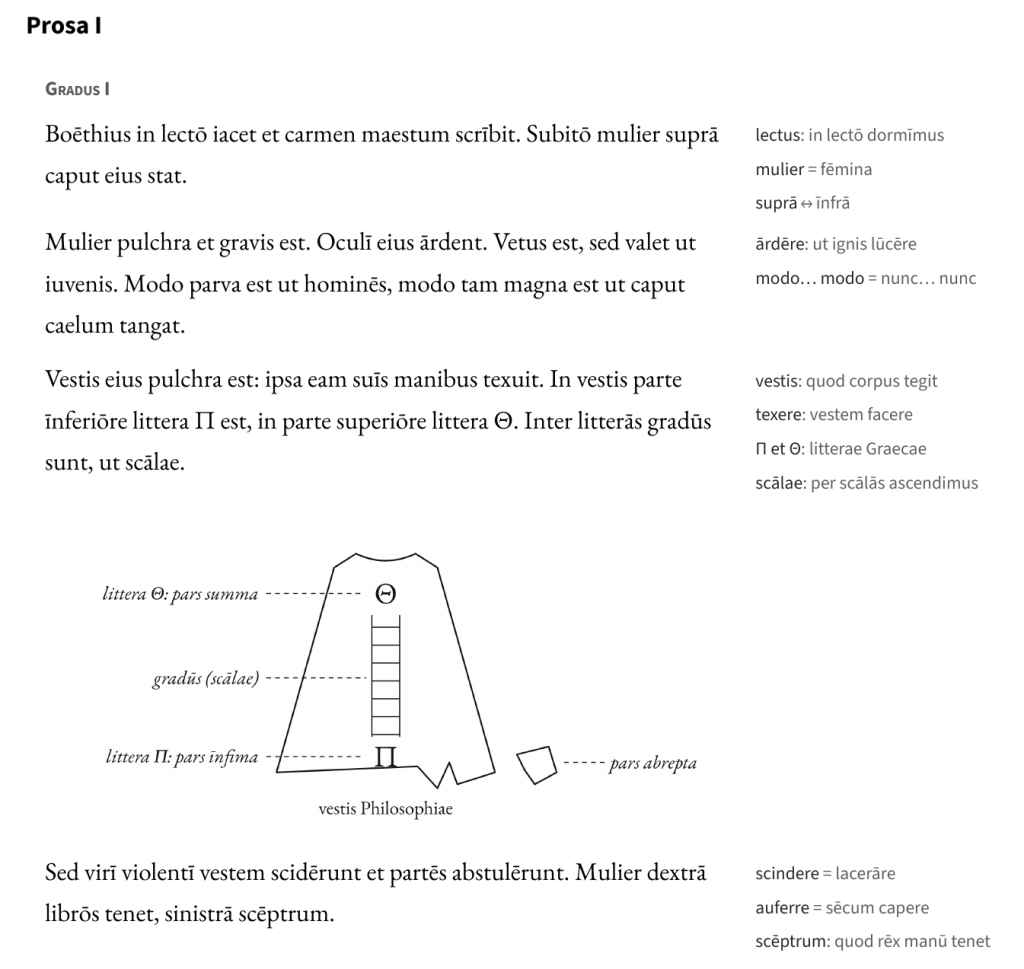
A handful of plain labelled line drawings carry some of the weight that pictures carry in Ørberg: Philosophia’s robe with its Π and Θ and the ladder between them (Book 1), Fortune’s wheel (Book 2), the house built on rock and on sand. They are diagrams, not illustrations in Ørberg’s sense.
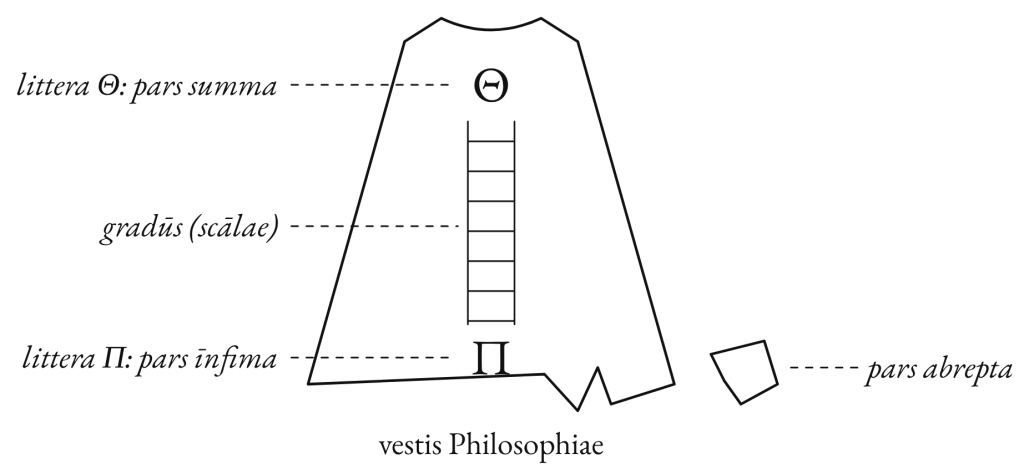
I had earlier considered getting an image model to produce the pictures, and that remains a possibility for a later edition.
Step five: a book
Once the five readers existed, I asked for a printable book. Google Docs cannot mirror margins for a bound volume, so the print version was typeset separately as a PDF: one 7 × 10 inch volume of 296 pages, with a half title, title page, colophon, table of contents, running heads, and each book opening on a right-hand page. The cover is dark red with cream type. We prepared it for Lulu’s print-on-demand service, checked the files against Lulu’s book creation guide, and ordered a single proof copy. It has not arrived as I write this.
What is not yet settled
This project is not quite finished; here is where it stands:
- The graded Latin is new Latin, and it was written by Claude. It has been read over once more by Claude and not yet by a trained second reader. Some of its choices are interpretive. For example, Prosa IV.36 of Book 1, “O meritos…”, is rendered as irony.
- Some references in the margin notes came from Claude’s memory and not from a commentary, such as the sword of Dionysius at Cicero, Tusc. 5.61–62. They need checking against O’Donnell.
- Macrons. Where the quantity was uncertain, as with Gothic names like Conigastus and Trigguilla, the vowel is left unmarked.
- Hyphenation. No Latin hyphenation patterns were available, so line breaks follow a syllable rule written for the occasion. A classicist would break a few words, such as ma-gis-ter, at the prefix instead.
- The scan. The Delphin paraphrase was read from OCR text and not from the page images, so any OCR error carries through.
The proof copy will show whether the gray margin notes print crisply, whether the text sits comfortably near the spine, and whether the line drawings hold up on paper. I will report back once it is in hand.
Sources
- James J. O’Donnell, Boethius: Consolatio Philosophiae (Georgetown University), text and commentary
- Boethii De consolatione philosophiae libri quinque, in usum Delphini (Valpy, London, 1823), Internet Archive
- Project Gutenberg #13316, Stewart and Rand, Loeb Classical Library
- Lulu Book Creation Guide
A note on how this post was written: I wrote it with the help of Claude, an AI assistant made by Anthropic. Claude drafted the text from the record of our work on the graded reader, and I reviewed and edited it. The graded reader itself was also produced with Claude’s help, as described above.
